<img src="https://www.inventive-7-intuition.com/807131.png" style="display:none;">

Mimer Tetra Systems

 
Connect directly into your Damm Tetraflex system without using donor radios. 
You will get access to all Tetra talk groups, messages, private calls etc. And you can mix and match with other radios in your dispatcher software. 
OVERVIEW

Connect your Damm system

When you are connecting an ordinary radio system to a SoftRadio dispatcher you will be using Network Interface boxes connected to donor radios that are part of the larger radio net.

This is no longer needed for DAMM Tetra systems. We have created a software option that allows a SoftRadio dispatcher to connect directly to the DAMM Tetra infrastructure via a TCP/IP connection.

The DAMM system appears in Mimer just like other radios do. Private calls to and from the operator as well as group calls and messages can be handled.

All other Mimer SoftRadio connected devices are available simultaneously, like Airband or Marine radios as well as phones and intercoms.

The DAMM private calls and talk group calls works just like any other radio calls in the SoftRadio system, so that they can be crosspatched to other groups, radios & phones.

 
CHOOSE YOUR SOLUTION

Two ways to connect your Damm Tetraflex

In order to suit every user, we have built two different solutions for using Damm Tetraflex together with Mimer SoftRadio.

They will both give you the flexibility of having each talk group in the Tetra system as a device panel in SoftRadio that can be handled in the same way as other radios. You can of course mix talk groups, radios, phones, and intercom and also make cross patches between the radio, talk groups and phone.

The two solutions are based on Damm´s own two interfaces and each will give you a few pro´s and con´s.

Compare TGW & AGW

Features and specifications side by side


Terminal Gateway
Mimer TGW
 
Application Gateway
Mimer AGW
Connection & Scale
Direct connection to Tetraflex over IP
Recommended number of dispatchers
5–100
1–5
Max talk groups in SoftRadio
8 / 60
60
Talk Groups
Talk groups selectable by operator
Talk group calls
Talk group texts (SDS)
Talk group status
Private Communication
Private call
Under development
Text messages (SDS)
Under development
Status messages
Under development
Advanced Features
Dynamic Regroup (DGNA)
Different priority levels on transmission
Reception of emergencies
Crosspatch to standard radios
Voice recording and transcription
Connection to MapView for positioning
List of logged on TETRA radios
Requirements & Hardware
Dongle needed in each dispatcher PC
Required
Needs SoftRadio XL
Required
Separate H/W server needed
Required
Terminal Gateway

Mimer TGW

The solution for those that need the basic functions and have a large number of operators.
Click here for TGW
Application Gateway

Mimer AGW

The solution for those who need full access to all functions. Suitable for a small number of operators.
Click here for AGW

Functionality

We have tried to reflect the operators most important needs when monitoring and talking to the Tetra users. All those functions are easily accessible, while other functions are hidden or not even implemented since they are just in the way of daily use.

All the basic Tetra functionality are there:

  • TalkGroup select and listen

  • List of logged on users

  • Contacts list and calls

  • Private calls in simplex and duplex
  • SDS and status, send and receive

  • Emergency call handling
  • Set up of DGNA Groups

  • Positioning together with Mimer MapView

Operation

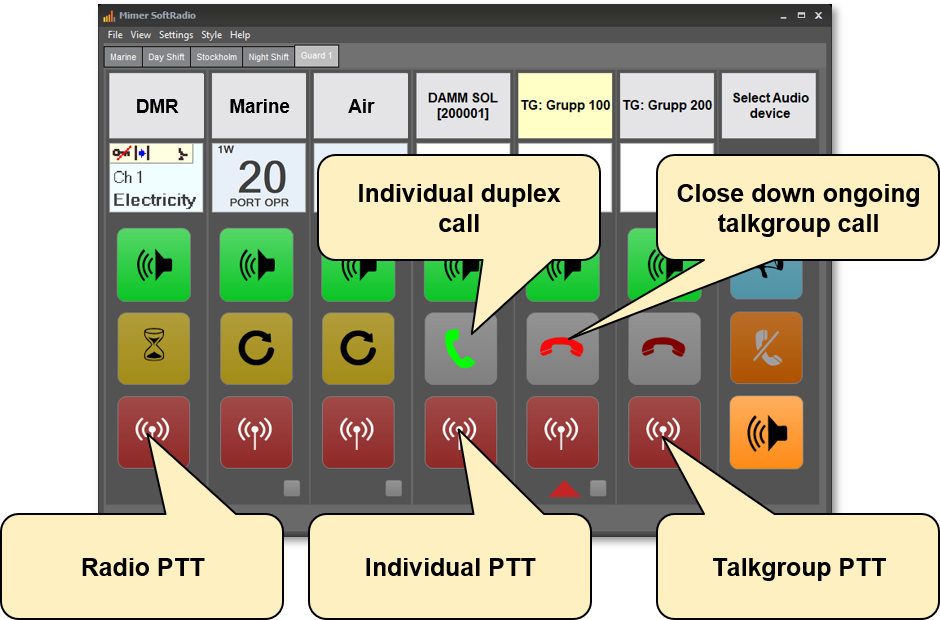
The operator will see a GUI that looks and behaves very much like standard SoftRadio does for other radio types. Each connected Talk group will be represented with a device panel that lets the operator make calls and answer calls.

All groups can be monitored in parallel and at the same time as other radio communication. When there are settings to do, or a message to send, device windows, much like the virtual control heads for radios, can be opened.

Voice Streams

In a Damm-system there is a cost for each voice stream used by the operator. If you have ordered to few voice streams, this could be a problem and you miss calls.
When using SoftRadio to Damm, to be sure that an emergency call is never missed, an incomming emergency will kill another call if there are no available voice streams, ensuring that the emergency gets through.

Screenshots

Damm32

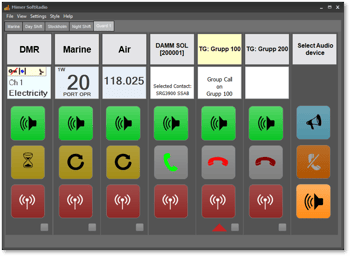
In the standard GUI for SoftRadio you will see one device panel for each attached talk group and one device panel for the system itself.

In this example also one DMR radio, one marine radio and one airband radio are connected to the same GUI.

Damm4B

Opening the window of the systems device panel shows a list of attached radios, a history list of calls and a history list of SDS and status messages.

Here you also choose radios for private calls and for messages.
Damm6

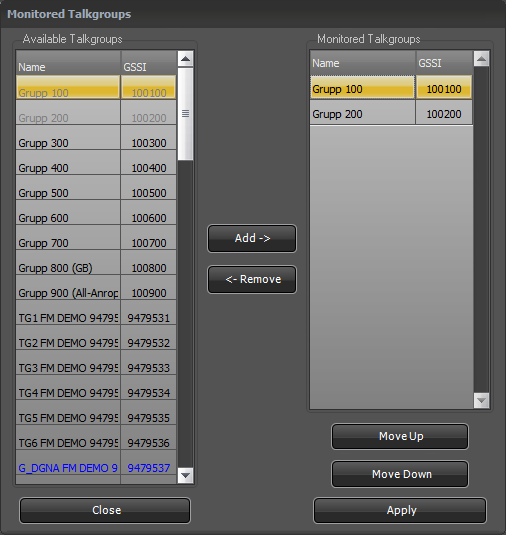
Each operator can choose which talk groups to monitor through an easy to use graphic interface.
Damm29

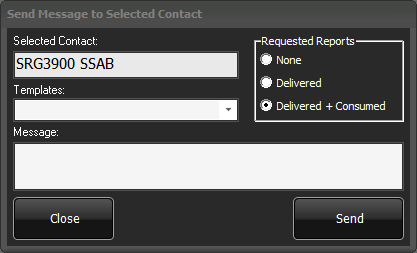
When sending an SDS message, the operator can choose different levels of reports on the message. In the history list this will be reflected by different icons depending on the message status.
Damm14B

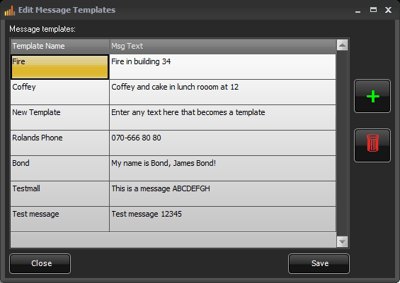
Templates can be set up for messages that are sent often.
Damm17

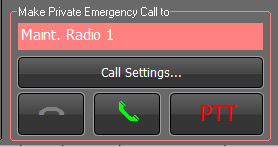
Both incoming and outgoing calls can have different priorities whith emergency as the highest.

This will be reflected with a pink colour and incoming emergency calls will get an audible signal so that the operators does not miss the call.

System Examples

SoftRadio-System-Damm-Tetra

Example with a dispatcher connected to a Damm system only working on the Tetra system
SoftRadio-System-Damm-Marineband

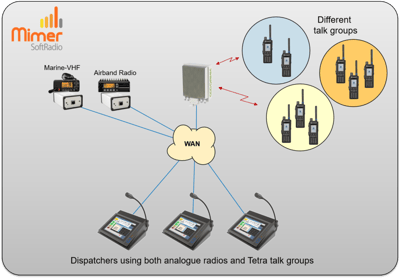
Example with three dispatchers connected to one Damm Tetra system and also to two radios for Airband and Marineband communication
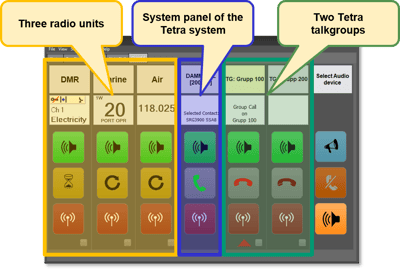
The SoftRadio GUI

SoftRadio-System-Tetra-Talkgroup

Radios, Tetra system and Tetra talkgroups.
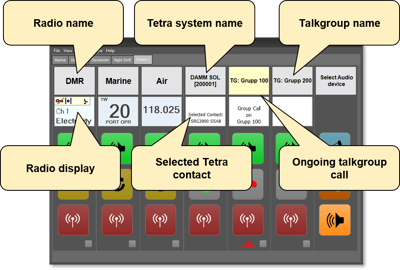
SoftRadio-System-Name-Labels-Info

Name labels and information.

SoftRadio-System-Damm-Keys

Different keys.