<img src="https://www.inventive-7-intuition.com/807131.png" style="display:none;">
 
Company Logo


Virtual Mimer RadioServer 

Technical description and set-up instructions for a RadioServer delivered as a virtual image file

Art n:o
3170 & 3170/04
Revision
P8
Release date
Aug 31, 2023

This paper describes the basic use of a Virtual Mimer RadioServer and how to set it up. There are two versions of the Mimer RadioServer; standard and satellite version. Both of these can be delivered ready to run in the standard box, or they can be delivered as a Virtual Service software package. There is a separate setup manual for the hardware version of the RadioServer. There is also a description of setups when using both a NetworkRepeater and a RadioServer. Please also refer to the standard setup instructions for SoftRadio and to the information provided on the web pages. 
General

Mimer RadioServer is a component in the Mimer family of products for network operated 2-way radios.

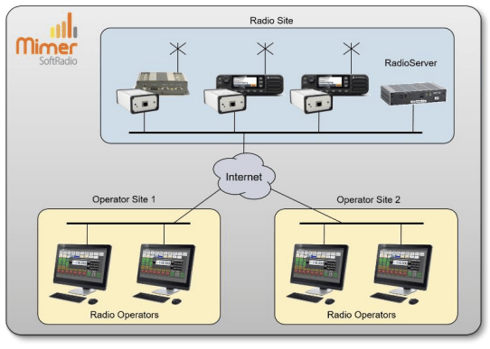
The RadioServer is used to allow many operators to remotely connect to one or more Mimer radios at a single site via TCP-connections. This can be used to allow access from users at different locations to radio resources at a single site, like a remote radio site or a command centre with local radios.

A standard Mimer Network interface allows only one user to connect remotely via TCP. If another user tries to connect he will get the alternating message “Trying to connect”/”Not connected” because there is no free TCP server socket to connect to. 


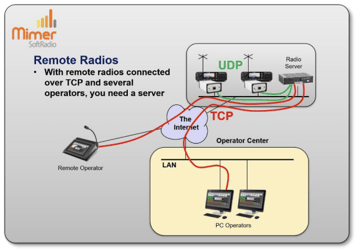
Typical setup where a RadioServer is needed, with three radios offshore and two sites with remote operators. 


3

Mimer Radio Server solves this situation by allowing many simultaneous operator connections for each radio attached to the server. The RadioServer can handle up to 128 locally placed radios and up to 128 operators, however a total of max 256 simultaneous connections are allowed.

This gives the following setup possibilities:

  • 2 radios x 128 operators

  • 4 radios x 64 operators

  • 8 radios x 32 operators

  • 16 radios x 16 operators

  • 32 radios x 8 operators

  • 64 radios x 4 operators

  • 128 radios x 2 operators

The RadioServer has two Ethernet connections. This means it can serve as a router to the Internet connection. By default, the local network connection has a static IP address and the WAN connection uses dynamic IP address assignment, but this can be changed if needed. The RadioServer can also be used in an existing Local Area Network (LAN) which has a router towards the Internet. In this case only the Local network connection on the RadioServer needs to be used. 

The RadioServer delivery 

Your delivery consists of a VMDK-file to be used as a disk image for your preferred virtualization platform.

The RadioServer is alternatively delivered on a rugged industrial x86 PC that runs a Debian based Linux operating system. See separate setup instructions 

Setup of the Virtual RadioServer 

The VDMK-file can be run on a virtual computer using Oracle Virtual Box or VMWARE. The Virtual machine will run a 32-bit Debian Linux machine. The virtual disk will be up to 4GB in size and requires at least 1GB of RAM (2GB recommended). The current virtual machine file has been created and tested using Virtual Box version 6.1. 

Setup instructions 

Please refer to the documentation for your virtualization platform for how to set up a new virtual machine using an already existing VMDK file.

4

The RadioServer 

The Radio Server is basically a special program for the RadioServer functions that runs on a computer under a 32-bit Debian Linux operating system.

It hosts an Http-server so that all settings can be done from a standard web browser 

Connections 

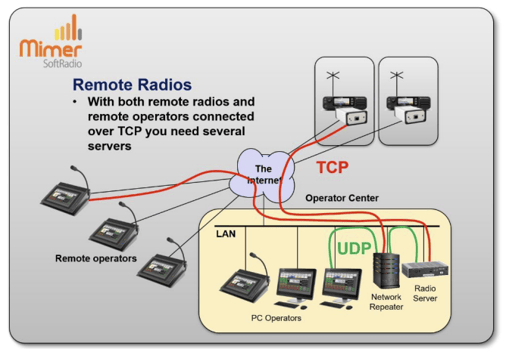
The radios that are in the same LAN as the RadioServer connects with UDP. The operators that connect through the Internet connects with TCP. 

The RadioServer links local radios to remote operators.

Virtual hardware

This manual describes the version of the radio server that is delivered as an image file in .vmdk format. It is a file with an image of a complete hard disk in a format that is easy to install under both Oracles “Virtual Box” and VMware “Workstation” or “Workstation Player”. Others may also run a vmdk-file directly or have tools available to convert this very common file format to run in the particular environment if so desired. For detailed instructions on how to install a vmdk-file please see the documentation for your selected virtualization software.

Properties of the virtual file

The Virtual machine will run a 32-bit Debian Linux machine. The virtual disk will be up to 4GB in size and requires at least 1GB of RAM (2GB recommended).

When running on a desktop computer the network adapter should be set up as a bridged adapter. 

The default configuration when virtual radio server is started is that there is an Ethernet interface eth0 with a static IP of 192.168.0.28

This and other settings can be changed via the web interface described below. The Radio Server also has an ssh server so it can be accessed with putty or scp as well. In this case only the root user is available. 


5

User accounts and default passwords

The virtual image has two users accounts configured:

root with password mimer

admin with password mimer

The root account can be used from a terminal or via ssh. Root has full access to everything, except that root cannot log in to the web interface.

The admin account has only access to the web interface.

Web interface for settings in the RadioServer

All settings are made using a standard web browser.

After logging on to the web interface you can change what radios to connect to, the IP-settings, the server name and the admin password. 


Connecting to the RadioServer

Accessing the web-interface

Use your favourite browser to connect to port 8080 of the radio server. Default would be: 192.168.0.28:8080.

Login

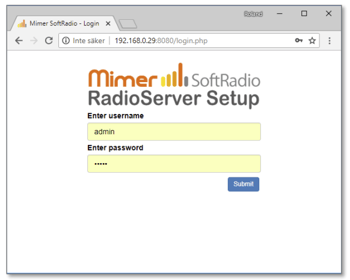
On the first page, log on with the username admin and the associated password (default is mimer).

The admin password can be changed using the web-interface. If so, please don´t forget to make a note of your changes, it might otherwise be impossible to reconnect to the RadioServer. 

RadioServer – Login page


6

Setting up connections to the devices

The first page is the setting of what devices that shall be connected to the RadioServer. This can be radios, phones, intercoms and other types of devices in the Mimer SoftRadio system.

The devices will be connected local through UDP over a LAN.

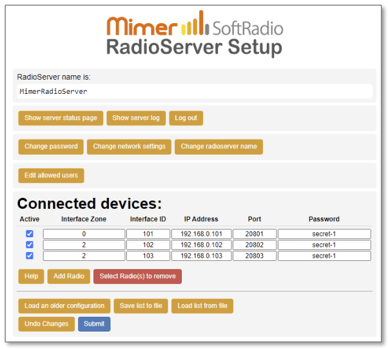
First push the button “Add Radio” so that the number of lines corresponds with the number of devices that you would like to connect. 

RadioServer – Setup page

Interface Zone

The Zone function is used in system with over 240 nodes. See separate manual. (Setting added from version 2.44)

Leave the Zone number at 0 for all system not using the Zone function!

Interface ID

This is the ID number used in the Mimer SoftRadio system for the device. In Mimer SoftRadio every device and every operator need to have a unique ID number from 10-240. Usually the SoftRadio clients have numbers from 10- 99 and all other devices numbers from 100-240.

The ID number of a device is determined by the setting in the Network Interface. 

IP Address

This is the IP address used in the local LAN connecting the device to the RadioServer.

The IP Address is determined by the setting in the Network Interface.

Instead of an IP address a URL can be used if you have an IP setup that allows local URL’s. 


7

Port

The port number is the TCP port used on the WAN side of the RadioServer to forward the SoftRadio clients to the correct device.

The corresponding port will need to be set up as port forward in the WAN´s fire wall pointing at the IP address of the RadioServer.

You also set up the same port number in the SoftRadio client. (The port number in the Network Interface is not used since it is connected local through UDP.)

Password

This is the password entered in the SoftRadio client setup.

(The password in the Network Interface is not used since it is connected local through UDP.)

Submit changes

After entering your changes in the list of devices you need to submit them to the RadioServer.

This is done by pushing the blue “Submit” button. A confirmation window will show that the RadioServer has accepted the new settings.

If you don´t want to submit the changes, you can just push the “Undo changes” button.

Save and Load from file

The keys “Save list to file” and “Load list from file” gives you the possibility to have several settings lists on your PC that you easily can change between.

Configuration history

The key “Load an older configuration” will present a list of older settings with time and date for setup. Any of these settings can be opened for review by selecting them. They will not be used until the “Submit” button is pushed again. 


8

Change network settings

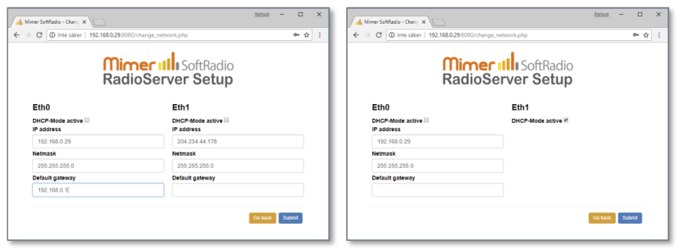
The standard settings delivered with the RadioServer are:

  • Eth0 – Static IP address, used for the local LAN to the devices.

  • Eth1 – Dynamic IP address, used for the WAN/Internet to the SoftRadio clients (might also be delivered as blank) 

RadioServer - IP setup page 


After you have done your changes, push the “Submit” button. 

Static IP – DHCP-Mode not active

Unticking the box means that you will use a Static IP, and that you define all the settings for the IP address yourself.

IP address

The static IP address of the RadioServer. You can change this to any address that suits your net. If you change the subnet part (often the three first groups) you must remember to also change the Mimer Network Interfaces accordingly.

Netmask

Defines the subnet part of the address. The standard setting 255.255.255.0 tells that the first three groups are the subnet address (in this case 192.168.0). If you only want to change the IP, you normally don’t need to change this setting.

Gateway

This is the address of your gateway out of the local subnet, normally the address of the Internet router. This field must usually be cleared if you use DHCP on the other Ethernet interface.


9

Dynamic IP – DHCP-Mode active

Ticking the box means that you will use a Dynamic IP, and the network you connect to have a DHCP-server that can assign an address and all IP settings to a computer that connects to it. The DHCP-server has a range of addresses that are assigned to a client when it sends a request. This is called dynamic address assignment.

Important note regarding Gateway settings

When using both LAN ports, only the WAN port shall have a gateway assigned (when it is set to DHCP it gets a gateway automatically). Leave the other LAN ports Gateway field blank. 

Other commands

Change password

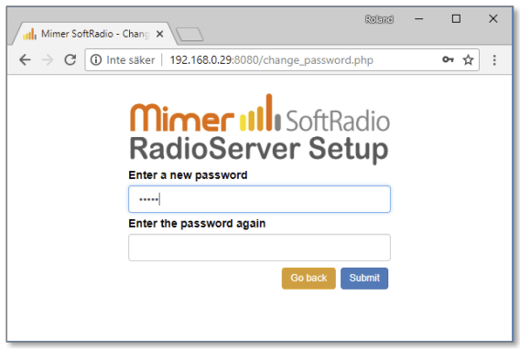
Pushing the “Change password” button will lead you to this page. 

RadioServer – Change password


If you wish to change your password for the RadioServer, just enter the new password in both boxes and push “Submit”.

If you change the password, please don´t forget to make a note of your changes, it might otherwise be hard to reconnect to the RadioServer. 


10

Checking RadioServer status

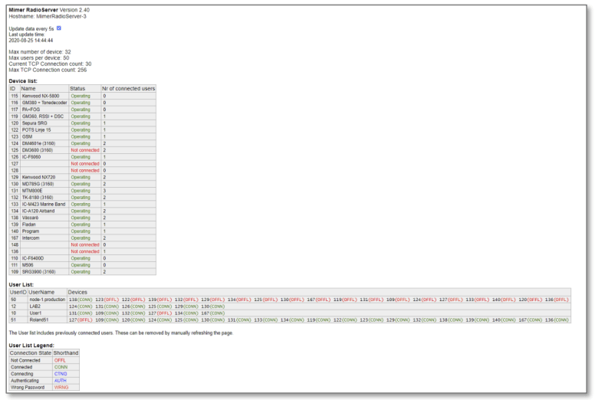
The status of the RadioServer can be checked by accessing it with a web browser. This is a read only page.

Type in the IP of the RadioServer and you will get a list as below. You can access it both over a local LAN and over the Internet*. Choose the Local or WAN IP address of the unit depending on how you access it.

There is also a button to get directly to the Status page from the RadioServer Setup window. Just click the button [Show server status page].

First you have some basic facts about the server. Then comes a list of connected devices and how many users that are connected to each device.

After that you have a list of the connected users and what devices they have connected to.

*Your Internet router must be set up to forward port 80 to the IP of the RadioServer. 

Web browser check of the RadioServer status


11

Show the server log

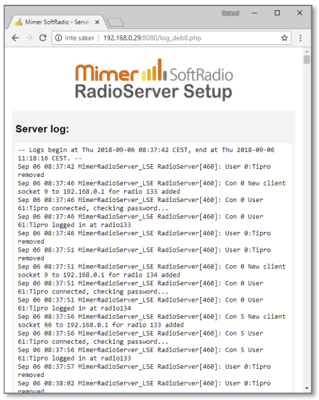
The server has a built-in log function that shows in detail every connection to the server. This can be useful when setting up a system or when fault finding a system. 

RadioServer log window

Allowed users

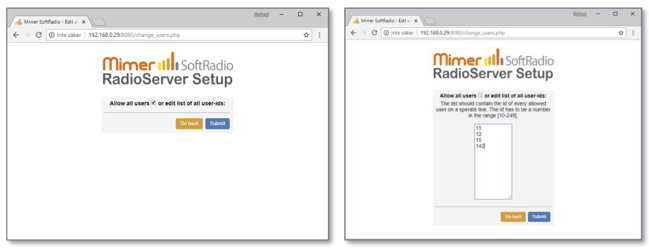
You can restrict which users in the SoftRadio system that are allowed to connect to devices through the RadioServer.

Click the “Edit allowed users” key.

Enter the SoftRadio ID numbers of the operators that shall be allowed access. One per line, in the range 10-249.

Or… Tick the box “Allow all users”, this means that there are no restrictions. 

RadioServer - Allow users menu


12

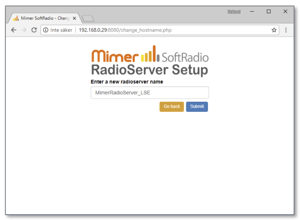
Change Server name

The name of the server can be changed by entering the “Change server name” menu. 

RadioServer - Change server name menu

Setting up the Mimer SoftRadio client

The SoftRadio client (Operator PC) needs to be set up to access the radios through the RadioServer instead of directly to the Network Interfaces.

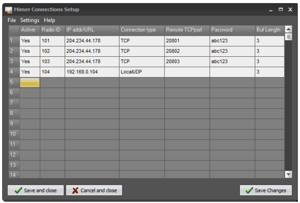
The only difference from connecting directly to a Network Interface using TCP is that the IP address of the RadioServer shall be specified instead of that of the Network Interface. And the TCP Port and the Password of each radio as specified in the RadioServer settings. 

Example of Mimer Connection Setup, in an Operator PC. Three radios connected to the RadioServer over TCP and one local radio.

If more than one radio is attached to the server there will be several radios in Mimer Connections Setup that all have the same IP Address = the address to the RadioServer.

In the example above, the user has setup three remote radios with an external IP and one remote radio with a local IP address. The NetworkInterface or in this case the RadioServer at the radio end of the system always needs to have a static IP address. If none is available a dynDNS service can be used. However each radio will need to have different ID numbers and different remote TCP-port settings as defined earlier in this manual.

13

Using both a RadioServer and a NetworkRepeater

In some system setups you need to use both a RadioServer and a NetworkRepeater. Typically, when you have both radios and operators spread out at different sites connected by the Internet. 


  • The NetworkRepeater connects to the radios that are at different sites with TCP over the Internet.

  • The local operators connect to the NetworkRepeater using UDP.

  • The RadioServer also connect to the NetworkRepeater using UDP.

  • The external operators then connect to the RadioServer using TCP over the Internet. 

Please compare with the drawing earlier in this manual where the radios are at the same site. Then the RadioServer is placed there and no NetworkRepeater is needed.

The use of both servers in the same system is further described in a separate guide “Using both RadioServer and NetworkRepeater” available on the download page https://lse.se/download-resources


14

Satellite version of the RadioServer

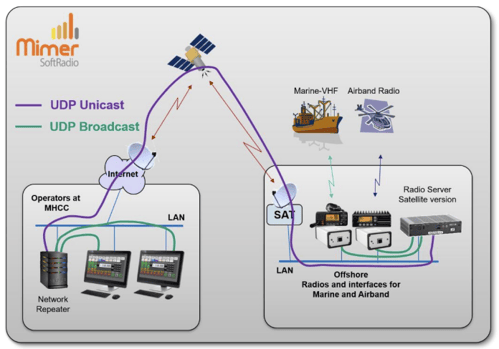
The satellite version of the RadioServer works slightly different from the standard version. The main difference being that it uses UDP Unicast on the WAN connection instead of TCP connections.

An important difference is also that you need to have a NetworkRepeater at the operator end. The operator software cannot handle UDP Unicast.

This setup will handle the long latency and the jitter that satellite links have, much better than the standard setup.

Many satellite links have a built-in function to make TCP connections “better” although there is a long delay in the actual connection. These are good for standard data transfers, and may work well enough for not encrypted connections. However, they are less good audio data connections and will not work at all for encrypted connections. Therefor the Satellite version uses UDP Unicast instead of TCP.

A typical setup can be like the picture below. 

  • The Network Interfaces, at the radios, connect to the RadioServer using UDP broadcasts.

  • The RadioServer connects to the Network Repeater using UDP Unicast.

  • The operators connect to the NetworkRepeater with UDP broadcast.


15

Mimer RadioServer summary:

 Max number of local radios   128 
 Max number of connected users   128 
 Total max IP connections (Radios x Users)   256 
 Remote access   Web based, ssh 
 Operating system   Debian Linux. 
 Default IP on eth0   


Note

The name “RadioServer” can mislead that this server can only be used for connecting radios in the Mimer system. This is not true. The connection can be to any device in the Mimer SoftRadio family. For example, phone-, intercom- or PA-system- Network Interfaces. 

Problem solving 

On our website we have an FAQ page. It has a section for common issues when setting up a system with a RadioServer. https://portal.lse.se/mimersoftradio/mimer-faq#technical-issues-regarding-the-radioserver


16
 
Mimer SoftRadio

Proudly made in Sweden

Connect Your Radios.
Anywhere. Over Any Network


Contact

LS Electronics AB

www.lse.se/contact-sales

info@lse.se